|
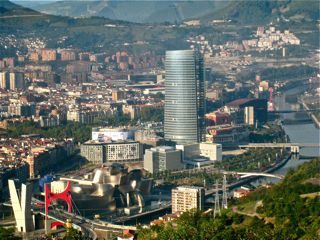
| Guggenheim at river level |
 |
| Gugginheim (Next to red bridge pier) |
Because you have all heard of the Guggenheim museum in Bilbao, designed by Frank Gehry (he was Canadian, you know; so we Americans really can't claim him!), I think it might be fun to make some other comments.


First, on the museum, it is everything you've heard it is: it is bigger than life, the exhibits are just my kind of art (VERY contemporary - you'll see Bos's pictures that he took furtively, when told NO PHOTOS INSIDE THE MUSEUM). The only surprising thing is that it is not out there alone on some plain or mountain, as all the pictures we'd seen seemed to indicate. But it is rather tucked into a city on a river and, from afar, it looks less than impressive (Comments as we look down on the city of Bilbao and the museum: "WHERE did you say it was? Is that it?? I can't see it!" "It's THERE, THERE" Bos pointing madly!) But, once you get into the city and used to the fact that its beauty is not because it is BIG, but rather it is unique, you forget the rest! And you will see lots of installation art, similar to MOMA or the Whitney in NYC.
 |
| Giant paintball gun randomly firing! |
 |
Fine Apartment Center city
Note elevator above building
Goes to streets behind and much
above this. There are several!
|
Now on to the rest. First, Bilbao may be officially in Spain. BUT it is really in the heart of the Basque country. The Basques have been a troublesome lot for both the French and the Spaniards from the beginning. You see, their "country" is really mountainous. And they truly have always wanted to be a separate country, belonging to noone but themselves. This is sorta like those pesky French in Quebec, who periodically long to be a separate country! Despite the fact that they were such troublemakers, both France and Spain have tried to claim them down through history and now it is Spain's turn to tussle with them. They have their own ethnic costumes, their own language in addition to Spanish, and even use the majority of their tax money for local Basque projects. Their city has revived itself with unique architecture and a very modern waterfront, parks, etc But, officially, they are Spanish. And, for our purposes, I'm going to talk a bit abut the differences we see between the French and Spanish. (My college roommate and friend, Kay Jarvis-Sladky, who was smart enough in the 60's to major in Spanish and teaching, will correct me I know!)
And I'm doing this on the pool deck of the ship, parked in the harbor of La Coruna, Portugal. Enough already, Bos and I said. We are tired --- both our soles and our souls need a break today! So we are going to see Portugal tomorrow and Saturday -- and we are chillin' out today!

French. The French people have something my mother kept saying: "Je ne sais quoi!" which means "I just don't know what". And it is true. It is hard to define. Words that might describe the French people we have met are: a bit aloof (not horribly, but it is there, for sure!), casual but formal or, Bos says, "Casually superior or smug". It is hard to imagine the French people sitting around playing a drinking game, or laughing boisterously.
On the other hand, from the minute you see them, the Spanish people are smiling, friendly, casual without that smugness -- and it is hard NOT to think of them sitting around playing drinking games or laughing all night! While the French are typically blonde with fine features and petite, the Spanish are darkly mysterious-looking, with smiles playing at the edges of their mouths even when they are walking somewhere. That "they are going to break they are so petite" feeling you have in France is totally gone in Spain, although the people are not corpulent by any means. They just seem to be sturdier. Which place would I like to explore more?? Of course, it is that mystery that appears to be Spain. Good thing we still have Valencia and Barcelona to visit on this trip!!
And dinner last night? We had dinner with an older couple and their doctor unmarried son, who takes them on a couple cruises a year. And the chief engineer for the ship. Who happens to be SWEDISH! And he hates lutefisk. These crew people, for the most part are married. The staff who wait on us are either from the Philippines or India. And they are gone from home for 7 to 9 months, get 2 months off, and then back on the boat for another 7 to 9 months. Makes our lives seem much more stable. But they say the pay helps their families at home and they are saving up for "the future". All in all, an interesting trip.


 We DID have the two hour bus ride from Barcelona to the Dali things. But when we got there, the bus parked far away and we, trying to stay semi-dry under umbrellas, tramped uphill to a movie theater that had been turned into Dali's museum. Now, we were looking forward to Dali, as Bos loves art, as does our son, Brent. But, when we got to the entrance, there were lots of groups pushing, shoving, trying to get in away from the deluge! So we got wet. Not just "wet", but soaked. And waited not so patiently until we could also shove and elbow our way into the museum. Which was so crowded with all the groups, all of them soaking wet, that the dank, damp smell added a kind of new dimension to the Dali works. After nearly 2 hours of shoving and scowling, we put up the umbrellas and slid downhill to where we thought the bus would be -- and waited again, not so patiently, until the driver showed up -- to drive us another hour to our luncheon. Which, by the way, was lovely. And we'd pretty much dried out by the time we got there! Now we are back in Barcelona, where the sun is shining and we are headed to Marseille. Been there before. And THIS time we are not being tricked by clever labels like "Panoramic" or "Little Walking." We KNOW how they try to seduce you! Ha!! So we are going to stay on board and pack up. Maybe have a massage. Or sleep late. Or even read a book. After all, the next part of the Irvine adventure will be just the two of us -- in a CAR -- driving through "Panoramic France" from a car window!!!